MEDEORA Data Network
We connect data from various sources, harmonize and analyze it, and use it to create a sustainable information base for research, public health, and the life sciences.
Existing systems and data sources can continue to be used and integrated into the data network.
The Challenge
Your data is already there. They're just scattered around.
Valuable information is generated in laboratories, research institutions, and other data-intensive projects. However, this information is often scattered across different locations, systems, and data formats.
Simply bringing this data together does not, in and of itself, create a
usable information base. Data must be imported in a structured manner
, standardized, verified, processed
, and managed on an ongoing basis.
Only then can a data network be created that makes trends visible and makes data usable for research, monitoring, analysis, and decision-making.
The Principle
From Distributed Data Sources to a Unified View.
Existing systems do not need to be replaced.
Data Sources
Laboratories, LIMS, LIS, files, databases, and interfaces
Data Integration & Harmonization
Mapping, Terminology, Units, and Quality Rules
MEDEORA Data Platform
Core Technical Infrastructure of the Data Network
Analysis & Visualization
Analyses, Dashboards, GIS, Trends, and Reports
Information & Decision-Making
Research, Public Health, Pharmaceuticals, and Life Sciences
PRACTICAL EXPERIENCE
A data network only works— —if it functions reliably over the long term.
MEDEORA has more than 20 years of experience in the medical and biological fields and extensive experience with networked data collections.
In the Clinical Virology Network, test results from multiple laboratories and various local systems are regularly consolidated. MEDEORA ensures that this data is imported in a structured manner, harmonized, quality-checked, and prepared for analysis and visualization.
CLINICAL VIROLOGY NETWORK
From Individual Data Reports to a Shared Epidemiological Perspective.
The CVN provides a practical demonstration of the components that must work together to ensure a long-term, functional data network .
- Continuous data import
- Processing Heterogeneous Data Sources
- Data Integration and Harmonization
- Quality Control
- Data preparation and initial analyses
- Geographic and temporal visualization
- Long-term technical operation
Making Data Visible
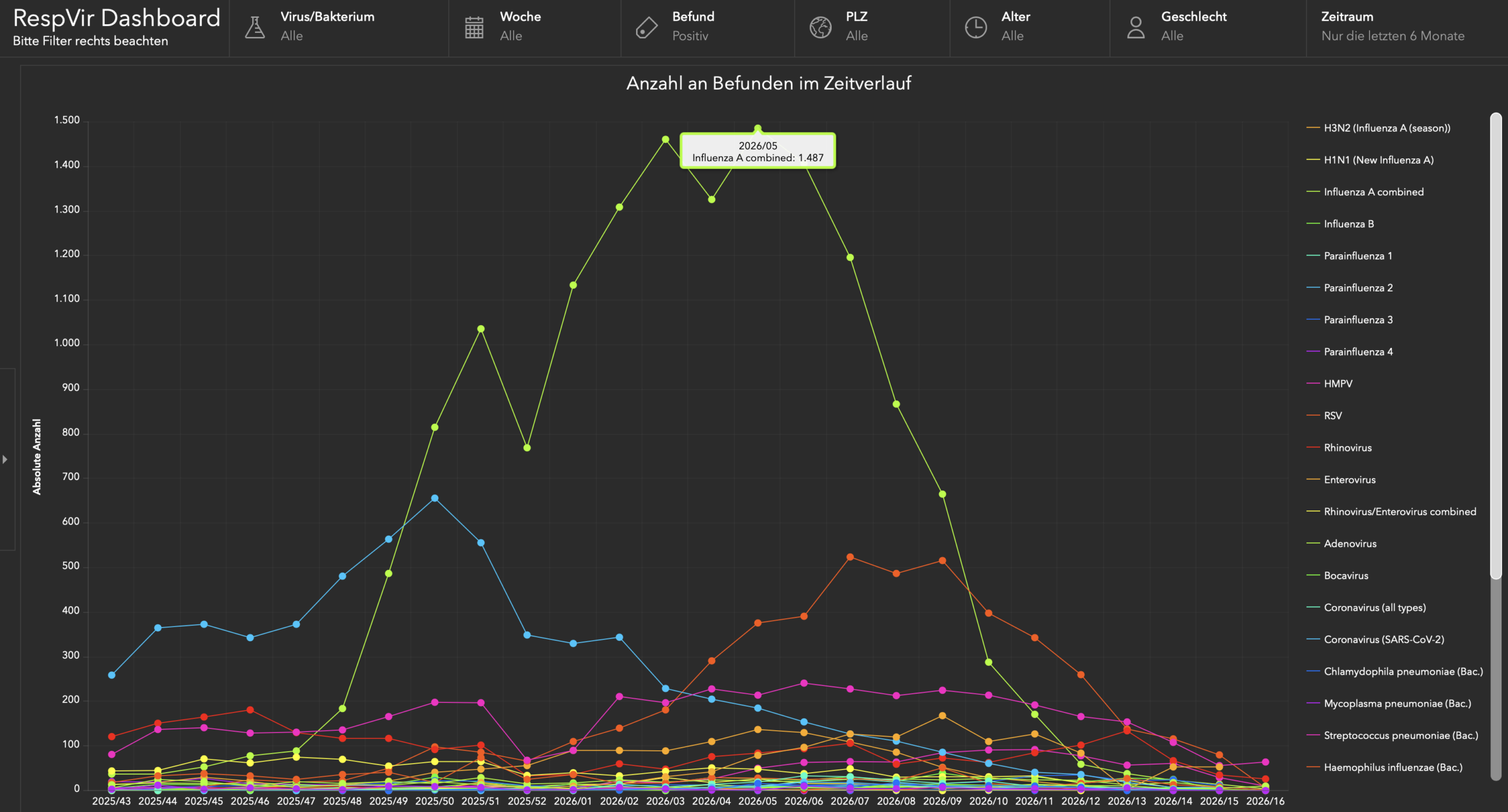
Distributed data is consolidated into a unified view.
Consolidated data can be analyzed by time, geography, and subject-specific criteria. The Clinical Virology Network uses interactive ArcGIS dashboards, among other tools, for this purpose.
More Than Just Software
Technology alone is not enough.
The technical platform is only one part of a successful data network.
Data sources must be connected, data structures aligned, information harmonized, data quality monitored, and results presented in a clear and understandable way.
That is why the MEDEORA Data Network combines technology, project experience, data integration, analysis, visualization, and long-term operation.
PLATFORM
MEDEORA Data Platform
Centralized data storage, user and access rights management, traceability, reporting, and interfaces.
INTEGRATION
Connecting Data Sources
Data models, interfaces, mapping, harmonization, and quality rules.
ANALYSIS
Preparing and Understanding Data
Data preparation, descriptive analysis, key metrics, trends, patterns, and comparisons.
INFORMATION
Making Insights Visible
Dashboards, reports, GIS, and other visualization and analysis tools.
OPERATIONS
Keeping the Network Running
Dashboards, reports, GIS, and other visualization and analysis tools.
Applications
For projects that make data from many sources available for shared use.
Pharmaceuticals & Life Sciences
Data infrastructures for epidemiological projects, observational studies, medical affairs, real-world data, and research collaborations.
Public Health
Data networks for surveillance, monitoring, sentinel systems, and regional and temporal analyses.
Research Networks
Shared data infrastructures for research consortia, universities, multicenter projects, and other scientific networks.
Diagnostics & IVD
Consolidation of reference, validation, research, and surveillance data across multiple sites.
Our Service Model
From an idea to a permanently operational data network.
PLATFORM
Technical Basis
MEDEORA Data Platform, data storage, user and permissions management, hosting, reporting, and interfaces.
INFORMATION
Establishment of the Network
Data model, data sources, interfaces, mapping, harmonization, quality rules, analyses, dashboards, and participant onboarding.
OPERATION
Ongoing Operations
Monitoring, data imports, data quality, Support, user support, Updates and further development.
Technical Basis
MEDEORA Data Platform
The MEDEORA Data Platform forms the technical backbone of the Data Network.
It handles the structured storage and management of incoming data and provides functions for flexible data models, user and rights management, traceability, interfaces, and reporting.
The platform can be customized on a project-by-project basis to accommodate various data sources and technical requirements at . Existing laboratory, research, and information systems can be integrated at without having to be replaced.
For analysis and visualization, established technologies such as ArcGIS ( ) and other reporting and analytics tools ( ) can be integrated.
Data protection, role and permission models as well as requirements for data flows and hosting are already taken into account during the technical design phase.
Privacy & Hosting
Privacy considered from the very beginning.
When processing and providing data, MEDEORA complies with applicable German and European data protection requirements, in particular the GDPR.
The servers used for data collection and hosting by the MEDEORA Data Network are located in Germany. Data protection, access rights, and secure data processing are taken into account right from the project design phase.
GDPR & Data Protection
Data processing and project design are guided by applicable German and European data protection requirements.
Hosting in Germany
The servers used for data collection and hosting are located in Germany.
Roles & Access Rights
Access to data can be controlled on a project-specific basis using user, role, and permission concepts.
Privacy by Design
Data protection, data flows, and access rights are taken into account right from the design phase of a data network.
Your Data Network
Would you like to make data from multiple sources available for shared use?
Talk to us early on about your project. Together, we’ll clarify data sources, data models, interfaces, harmonization, analyses, visualization, data protection requirements, and the future operation of the network.

