
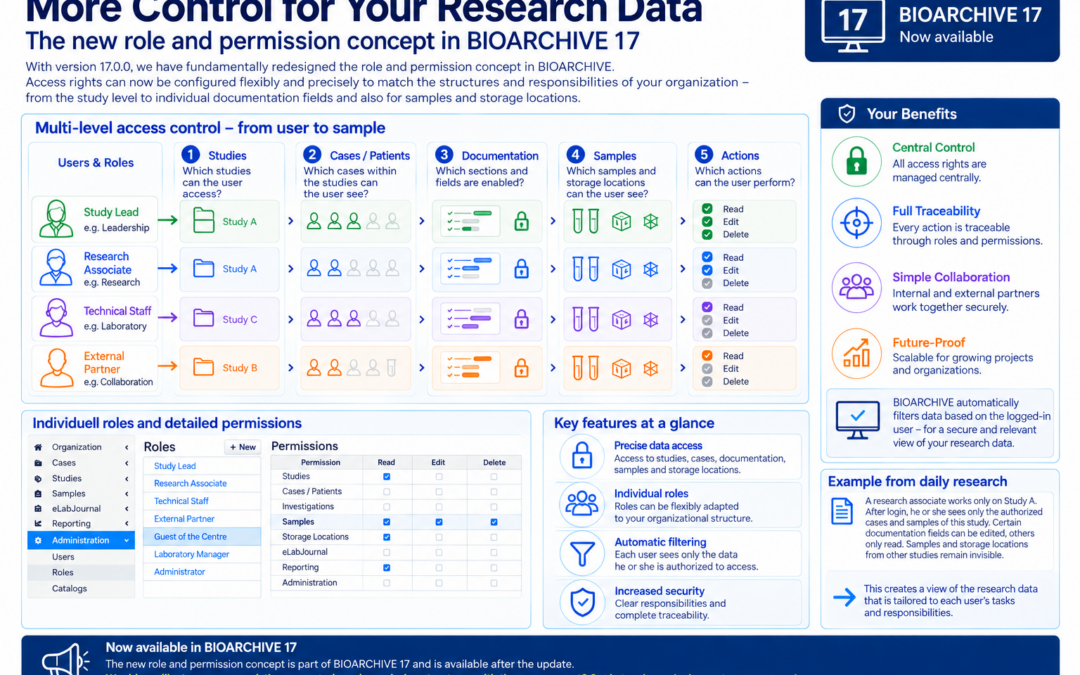
Who is allowed to view—and edit—what?
With BioARCHIVE 17, we have completely overhauled the existing role and permission model. Whereas access rights were previously controlled through predefined roles, the new model allows for an almost entirely customizable configuration of roles and permissions.
This allows for much more granular control over access—ranging from studies, cases, and investigations to samples and storage locations, as well as electronic lab journals and individual documentation fields configured specifically for each organization. Read, write, and delete permissions can be assigned selectively for each area.
A real-world example
A lab staff member may view and edit samples from a specific study, but may not delete them. At the same time, sensitive patient data and information from other studies remain hidden from them. A study director, on the other hand, may be granted more extensive access rights in accordance with their role.
The result: Each user can view and edit only the information they are authorized to access—even when multiple research groups are collaborating with BioARCHIVE.
The following diagram illustrates the various levels of the new rights management system and shows how flexibly individual permissions can be configured.
Would you like to learn more about BioARCHIVE or find out more about the new roles and permissions model? Please contact us—we’d be happy to show you the possibilities in a personalized presentation.

